
Le flux Seconde vie
Le problème des bobines « intelligentes » d’aujourd’hui
Section intitulée « Le problème des bobines « intelligentes » d’aujourd’hui »Quand une bobine taguée par un fabricant se vide, le tag meurt avec elle : il décrivait une bobine remplie en usine, dans le format d’un seul constructeur, et il ne peut pas être réutilisé. Le support de bobine finit à la poubelle ou rechargé « bêtement ».
Seconde vie : réidentifier plutôt que jeter
Section intitulée « Seconde vie : réidentifier plutôt que jeter »Une puce TigerTag est inscriptible et réinscriptible. Quand une bobine est vidée puis rechargée — ou quand une bobine, quelle que soit sa marque, ne porte aucun tag utile — l’utilisateur encode une puce TigerTag avec le profil réel du nouveau filament et la colle dessus. La bobine reçoit une seconde vie d’objet à part entière, capable de s’identifier :
flowchart LR
  A[Spool empty / untagged] --> B[Refill or re-purpose]
  B --> C[Encode TigerTag chip<br/>brand · material · color · settings]
  C --> D[Spool re-enters inventory]
  D --> E[Weight tracked, rack-mapped,<br/>shared, printable]
  E -->|emptied again| B
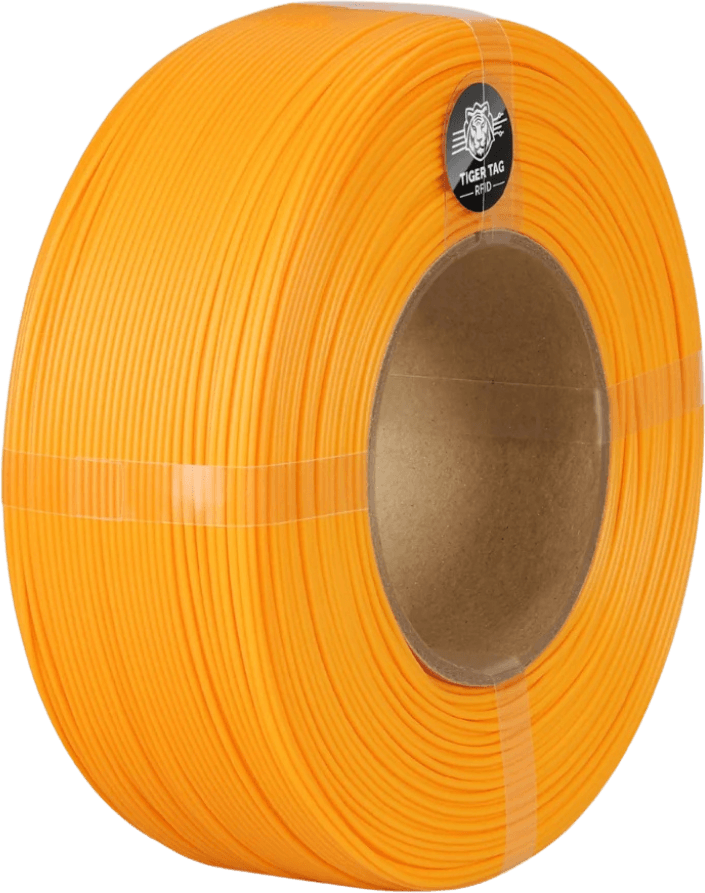
Même une recharge sans bobine porte son identité — la puce voyage avec la couronne elle-même.
Comment se passe l’encodage
Section intitulée « Comment se passe l’encodage »- Tiger NFC Connect (mobile) — programmez les puces par simple contact NFC.
- Tiger Studio (bureau) — mise à jour guidée de la puce avec un lecteur ACR122U / TigerPOD : posez la puce, vérification de correspondance de l’UID, écriture vérifiée.
- Le numérique d’abord — le TigerData de Tiger Studio vous laisse créer une bobine entièrement numérique (sans puce) maintenant et la promouvoir en puce réelle plus tard, de façon atomique.
Note : le catalogue des marques, matières et couleurs utilisé lors de l’encodage est servi par la base de données de référence partagée, si bien qu’une puce réencodée est aussi précise qu’une puce d’usine.
La seconde vie de la puce elle-même — zéro déchet électronique
Section intitulée « La seconde vie de la puce elle-même — zéro déchet électronique »La bobine n’est pas la seule à recevoir une seconde vie : les puces aussi. Chaque bobine porte deux puces — donc chaque kilo de filament que vous imprimez vous laisse deux puces NTAG standard à récupérer. Décollez-les et réencodez-les en NDEF simple pour n’importe quel usage : un porte-clés intelligent, une carte de visite NFC, un objet connecté à vous — l’éditeur est intégré à l’application. Elle peut même réécrire une puce dans le format qu’attendent les imprimantes Elegoo : votre puce, votre choix.
C’est exactement pour cela que la production des puces officielles de marque est passée au NTAG215 : plus de marge mémoire, donc plus de réemplois possibles une fois la bobine vide. L’objectif est simple — la puce d’une bobine ne devrait jamais devenir un déchet électronique.