
The TigerTag chip (RFID/NFC format)
Physical layer
Section titled “Physical layer”| Property | Value |
|---|---|
| Chip family | NTAG213 / 215 / 216 (NFC Forum Type 2) |
| Recommended form factor | 25 mm round sticker (other shapes work) |
| Payload | 144-byte NDEF payload — sized to fit the small NTAG213; larger chips leave unused space |
| Official branded chips | Produced as NTAG215 — the extra memory maximizes end-of-life reuse (standard NDEF objects) so the chip never becomes e-waste |
| Authentication | None — openly readable |
| Write lock | None — chips ship unlocked; the user can rewrite them, including migrating to another protocol entirely |
| Reserved area | 64 bytes at the end of the payload — pages 0x18–0x27, leaving 80 bytes of data. On a standard TigerTag they are free for community add-on functions; on a TigerTag+ they carry the origin signature, 32 bytes of R and 32 of S (byte-level layout: TigerTag-RFID-Guide) |
| Chips per spool | Two, placed on opposite sides |
| Readable by | Any NFC smartphone, ACR122U-class USB readers, TigerPOD |
This is the deliberate opposite of manufacturer tags (Mifare Classic with derived keys, AES sectors, RSA signatures — see compatibility): a TigerTag chip hides nothing.
Think of the chip as long-term cold storage for the spool’s identity: the data lives on the chip itself, offline, for years — no server, no account, nothing required to keep it alive. The online layer (reference database, cloud sync) only ever adds freshness on top.
Why every spool carries TWO chips
Section titled “Why every spool carries TWO chips”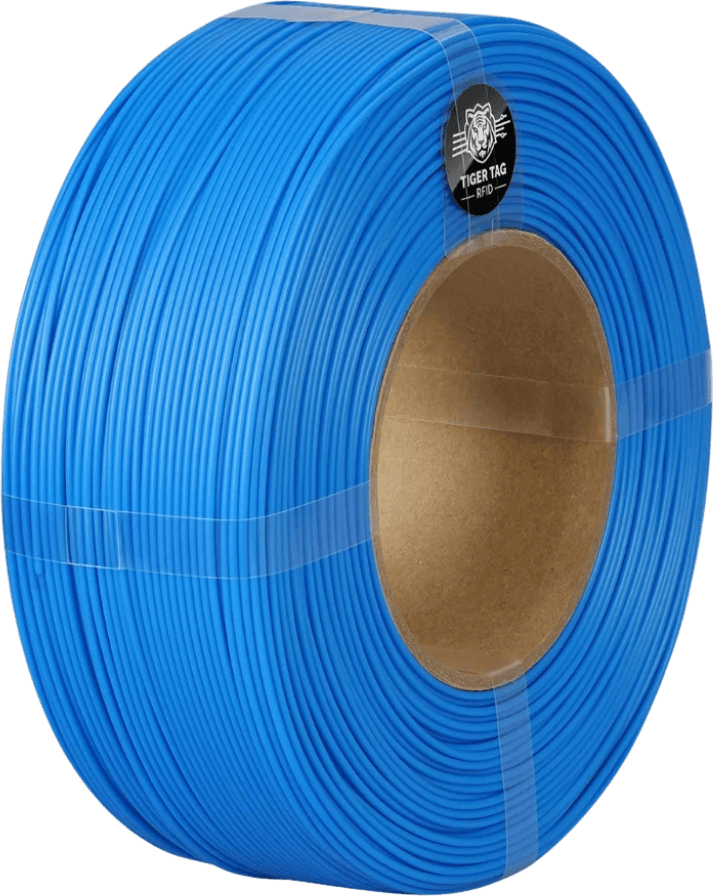
Two chips, on opposite sides of the spool — it looks redundant, it’s actually the smartest detail of the format:
- Printers share readers. A machine typically has one RFID reader for two spool slots, mounted between the two — or on the side of the printer, where it reads the left or the right face depending on which slot your spool is in. A Bambu Lab AMS has 2 readers for 4 slots; on a Snapmaker the spool sits either side of the printer. With a chip on each side, whatever the slot, one chip always faces the reader — and you never have to load the spool a particular way round.
- No hunting for the chip when you scan by hand. On a TigerPOD or with your phone, you never have to work out which face carries the chip: whichever way you pick the spool up, one is already on the right side for what you are doing.
- Scan in place. A spool mounted on an AMS Lite, the side of an Elegoo Centauri Carbon or a FlashForge can be scanned without pulling it out.
- Integrator freedom. A filament-dryer maker just puts the reader wherever fits — left or right for a single-spool dryer, between the two spools for a dual — and it always works.
- Redundancy. If one chip stops answering, the other still identifies the spool — and serves to repair the broken one.
- Double the harvest. At end of life, every kilo of filament printed leaves you two reusable NTAG chips for DIY projects (zero e-waste).
A few implementation details:
- The two chips are fully independent — each has its own UID; there is no shared antenna. They are written together as a pair (Twin Tag) and kept identical for the spool’s whole life, down to the grams left — and always counted as one spool.
- On factory spools, the chips ride a carrier: a strip whose two ends fold over the cardboard core (one chip per end), held with industrial 3M adhesive (468MP / 200MP) — the operator peels and sticks, nothing else changes on the line. The carrier design is public and printable at home, and the same form is sold on its own for refills, so the chip travels with the filament instead of with the reel.
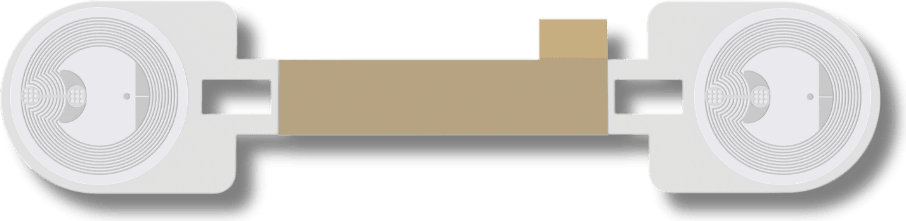
The carrier, bare: the two independent antennas are plainly visible — one per folded end, each with its own UID.
How the two chips are bound
Section titled “How the two chips are bound”Nothing central records the pair. It is inferred from what the two chips carry, and the field that makes it deliberate rather than coincidental is the timestamp.
The 4 bytes at page 0x0C (offset +32) serve a double purpose: seconds
since 2000-01-01 GMT, and the Twin Tag ID. Two chips written in the same
session receive the exact same value — that shared second is the pairing key.
Resolution is one second, so the timestamp alone is not proof: two spools tagged within the same second would carry it too. What confirms the pair is that the descriptive identity matches as well — the two chips describe one spool, so every field describing that spool must be identical on both:
| Field | Page | Offset |
|---|---|---|
| Twin Tag ID / timestamp | 0x0C |
+32 |
| ID Brand | 0x07 |
+14 |
| ID Material | 0x06 |
+8 |
| ID Aspect 1 · ID Aspect 2 | 0x06 |
+10 · +11 |
| Color 1 · Color 2 · Color 3 | 0x08 · 0x0D · 0x0E |
+16 · +36 · +40 |
| ID Product | 0x05 |
+4 |
What actually discriminates depends on the variant:
- On a TigerTag+,
ID Productis a real catalogue id. Same timestamp and same product id is enough to call it a pair with near certainty. - On a standard TigerTag,
ID Productis the constant0xFFFFFFFFon every chip in existence, so it carries no discrimination at all. The brand, the material, the three colors and both aspects do that work instead — together with the timestamp.
Two consequences worth stating plainly:
- Writing the chips in two separate passes does not produce a pair. They receive two different timestamps, so nothing binds them and the ecosystem counts two spools. This is why the phone app writes both in a single Dual NFC session, and why the TigerPOD holds two readers facing each other.
- The signature is the one thing that legitimately differs. On a TigerTag+
it signs
SHA-256(uid ‖ id_tigertag ‖ id_product), and each chip has its own UID — so the two chips of a pair carry two different signatures, by construction. Identical signatures would mean a copy, not a twin.
Offsets above are quoted from the canonical TigerTag-RFID-Guide (§2.9), which remains the specification.
The refill carrier, in practice
Section titled “The refill carrier, in practice”Two details that surprise people:
- Gluing it is optional. The 3M adhesive is there to hold the carrier while you handle and store the refill. Once the refill is mounted on the masterspool, the carrier is wedged between the masterspool and the cardboard core and cannot move — the glue has nothing left to do.
- It comes back out, and it is reusable. When the refill is finished, recover the carrier with its two chips, erase them from Tiger NFC Connect or Tiger Studio, and use it again — on another spool, or for any other NDEF project. Filament sold with a TigerTag Refill leaves you the carrier, not waste (second life).
Where to get one: see buying the chips.
Encoded at the factory, or blank in your hand
Section titled “Encoded at the factory, or blank in your hand”The same chip reaches you two ways, and the difference matters more than anything else on this page:
| Where it comes from | What is on it | |
|---|---|---|
| Pre-encoded | integrated on the production line, inside filament from a partner brand | the spool’s full identity, ready to read |
| Blank | bought on its own — TigerTag-branded, or any NTAG chip from anywhere | nothing yet; you write it once, in about a minute |
Chips sold separately ship blank, logo or no logo. That is not a limitation: an unwritten chip is what makes second life possible, and it is why the protocol never depends on buying anything.
Payload
Section titled “Payload”The 144-byte payload encodes the spool’s universal identity — brand, material, aspect/color, type, diameter, print settings — as IDs resolved against the shared reference database.
TODO: byte-level field layout. The canonical specification lives in TigerTag-RFID-Guide; this page should summarize it (offsets, versioning, ID tables) once finalized there. Never document offsets here from memory.
Reading and writing
Section titled “Reading and writing”| Tool | Read | Write |
|---|---|---|
| Tiger NFC Connect (mobile NFC) | tap the chip — the spool opens on the phone | tap Make and tap again to write; Dual NFC writes a spool’s two chips in one session |
| Tiger Studio + ACR122U/TigerPOD | auto-opens the spool on scan | guided, UID-checked write |
JS SDK (tigertag on npm) |
decodes the 144-byte payload | encodes a new payload |
| Python SDK | decodes the payload; tigertag[verify] also checks the signature |
encodes a new payload |
The two apps talk to the reader; the SDKs do not. An SDK decodes and encodes the payload — bring your own NFC hardware.
Versioning
Section titled “Versioning”The payload carries a format version (reference table id_version), so readers
can stay compatible with older chips.
Related: TigerTag, SDKs, Compatibility