
The Second Life workflow
The problem with “smart” spools today
Section titled “The problem with “smart” spools today”When a manufacturer’s tagged spool runs out, the tag dies with it: it described one factory-filled spool, in one vendor’s format, and it cannot be reused. The spool holder gets thrown away or refilled “dumb”.
Second Life: re-identify, don’t discard
Section titled “Second Life: re-identify, don’t discard”A TigerTag chip is writable and rewritable. When a spool is emptied and refilled — or when a spool of any brand has no useful tag at all — the user encodes a TigerTag chip with the new filament’s real profile and sticks it on. The spool gets a second life as a first-class, self-identifying object:
flowchart LR
  A[Spool empty / untagged] --> B[Refill or re-purpose]
  B --> C[Encode TigerTag chip<br/>brand · material · color · settings]
  C --> D[Spool re-enters inventory]
  D --> E[Weight tracked, rack-mapped,<br/>shared, printable]
  E -->|emptied again| B
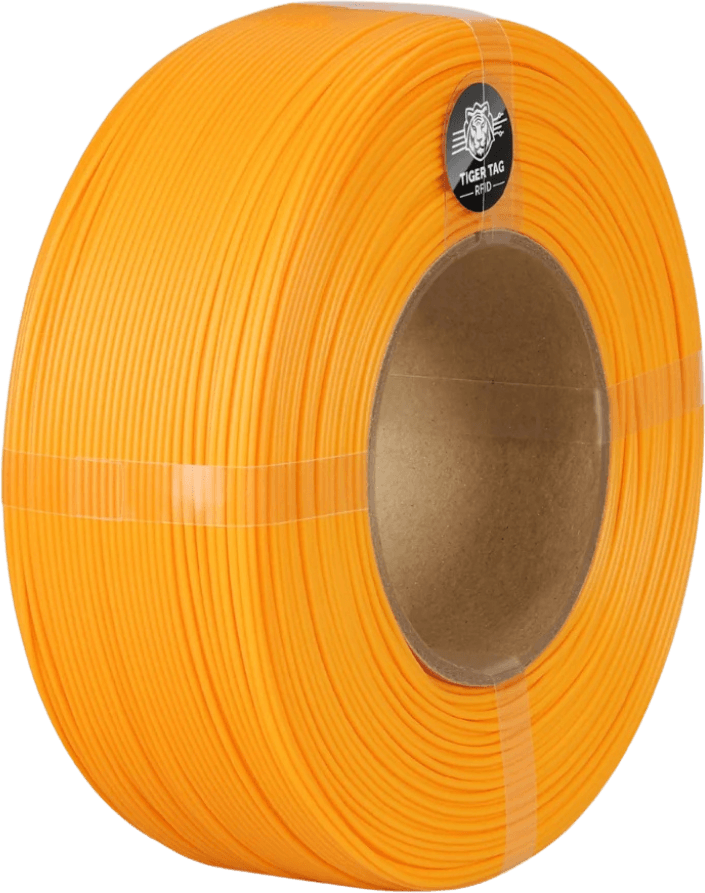
Even a spool-less refill carries its identity — the chip rides the coil itself.
How encoding happens
Section titled “How encoding happens”- Tiger NFC Connect (mobile) — program chips by NFC tap.
- Tiger Studio (desktop) — guided chip update with an ACR122U / TigerPOD reader: place the chip, UID-match check, verified write.
- Digital-first — Tiger Studio’s TigerData lets you create a fully digital (chipless) spool now and promote it to a real chip later, atomically.
Note: the catalogue of brands, materials and colors used when encoding is served by the shared reference database, so a re-encoded chip is as precise as a factory one.
The chip’s own second life — zero e-waste
Section titled “The chip’s own second life — zero e-waste”The spool isn’t the only thing that gets a second life: the chips do too. Every spool carries two chips — so every kilo of filament you print leaves you two standard NTAG chips to harvest. Peel them off and re-encode them as plain NDEF for anything: a smart keychain, an NFC business card, a connected object of your own — the editor is built into the app. It can even rewrite a chip in the format Elegoo printers expect: your chip, your choice.
That’s exactly why official branded chip production switched to NTAG215: more memory headroom means more reuse possibilities once the spool is empty. The goal is simple — a spool’s chip should never become electronic waste.